The Business Case for Trauma-Responsive Leadership: Retention, Risk, and Results That Show Up on the Balance Sheet
The director had been in the role for eleven weeks when the third, high-level resignation letter landed on their desk.
On paper, the department had a staffing problem. Two years earlier, budget cuts eliminated multiple supervisor roles. The leader who made those calls left six months later, and the interim lasted nine. Seasoned people now drifted out, and each departure added work to whoever stayed. The new hires were both capable and green, and with no supervisor to learn from, they were gaining experience primarily through trial and error – errors that were landing hardest on the people already stretched the thinnest.
This leader is a composite, drawn from patterns we encounter repeatedly: in hospital systems, corporations and organizations big and small, education, government, and private industry. If you’ve ever led through a few lean years, you undoubtedly engaged with this department; you may even be the one running it.
The resignation is the tip of the iceberg
Systems thinkers often draw problems like this as an iceberg. Outcomes (in this case, the letter on the desk) sit above the water, obvious for all to see. Below the water line live multiple layers that add up, keeping Outcomes – good and bad – afloat.
Behavioral Patterns live just beneath the surface: the unvoiced concerns, meetings that have become triage, email routinely answered at 11 p.m. by those also covering vacated roles. Below these patterns are the Systems and Structures that produce them: the missing supervisor roles, schedules that changed without warning, errors – or blame – assigned in front of the whole team. At the bottom are the Mental Models that hold everything above them in place: the beliefs that suggest a quiet dashboard means a healthy unit, that resilience is an individual’s job, that psychological safety means comfort or “playing nice.”
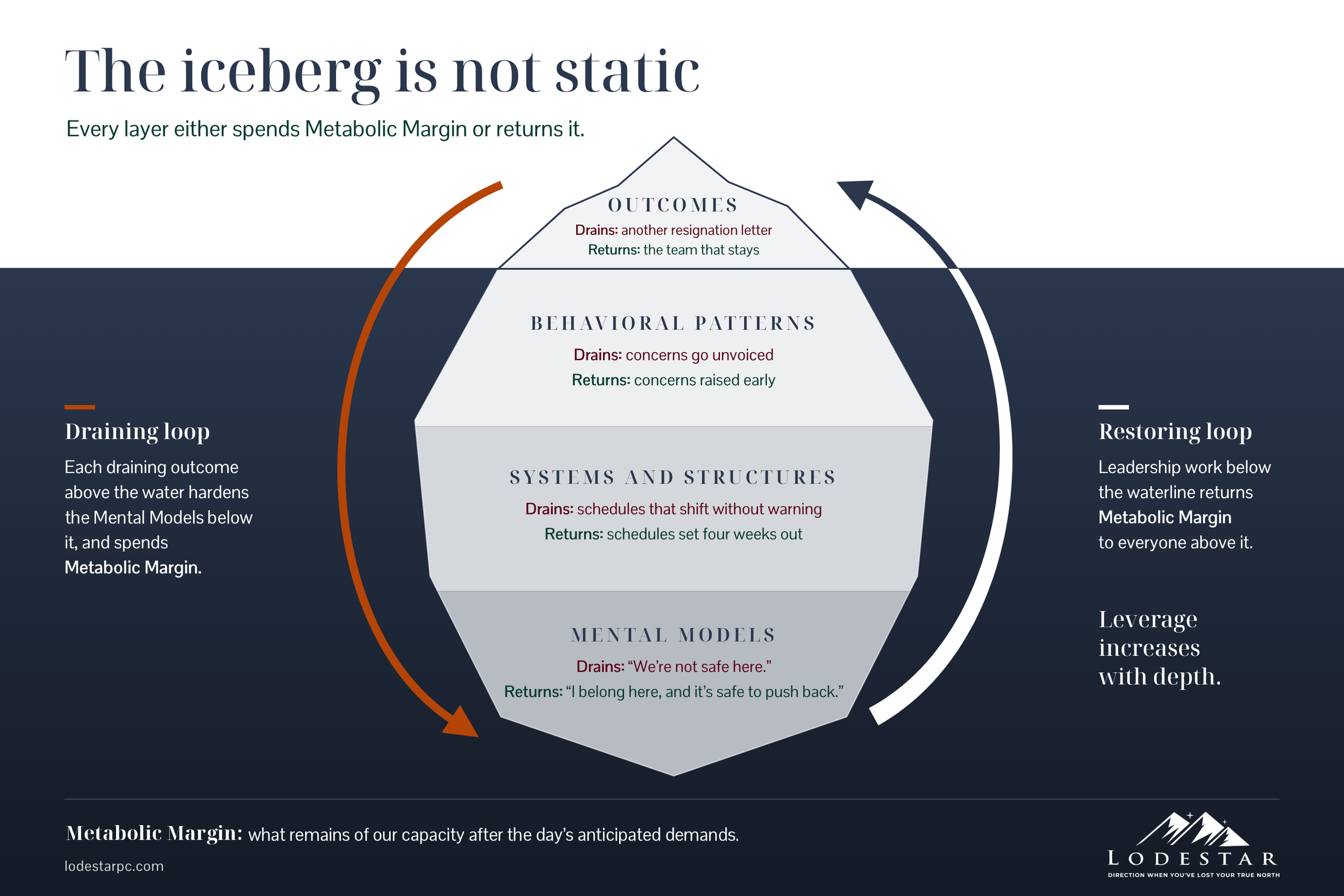
The iceberg is not static: Outcomes, Behavioral Patterns, Systems and Structures, and Mental Models, with the draining and restoring loops of Lodestar’s Metabolic Margin.
Systems theorist Donella Meadows once wrote that the best or most impactful “leverage points are not intuitive. Or if they are, we intuitively use them backward, systematically worsening whatever problems we are trying to solve” (Meadows, 1999). A retention bonus or a new strategic plan may appear to be a “solution” for the obvious problem (outcome) we see at the top; neither solves the Mental Models that are shaping team interactions – particularly when the team’s Mental Model has them braced for the next blow. The deeper the layer, the more leverage a change carries.
In other words, the highest yield changes a leader can make live deep beneath the surface, residing in the Mental Models that shape our workplace culture and interactions.
The iceberg is not static
While often drawn or taught as if they are fixed entities, the layers of our iceberg are dynamic, creating feedback loops. Draining Outcomes up top (another resignation) reinforce the Mental Models at the base (we’re stretched too thin; the organization is failing; we’re not safe). What shows above the water deepens what sits below it. Exhausted people withdraw, dial back, or leave altogether, leaving more work for the people who stay. The extra work intensifies the exhaustion. Each resignation reinforces the structure that produced it.
Fortunately, this system can also run the other way and build capacity. Positive Outcomes reinforce healthy Mental Models, and that direction is easy to see. More challenging – and ultimately much higher yield – is the work of creating the conditions for the healthy Mental Models that, in turn, produce strong systems and structures, reinforce affirming behaviors and ultimately lead to positive Outcomes.
This work below the waterline is intensive, deliberate, and requires that those who lead the efforts have what we at Lodestar call Metabolic Margin.
Metabolic Capacity is the finite reserve of physical, cognitive, and emotional energy available to absorb the day’s demand. Metabolic Margin is what remains of that capacity after the day’s anticipated demands: the reserve that absorbs what the day actually brings.
Most leaders are familiar with the concept when it comes to financial margin, recognizing that budgets stretched so thin they can’t absorb the cost (for example) of an HVAC failure quickly move beyond “challenge” into crisis.
Each human nervous system, and each team’s collective capacity, keeps a similar budget. The brain’s core work is allostasis: anticipating the body’s energy needs and preparing to meet them before they arise (Barrett & Miller, 2026). It does this by prediction, matching what is happening now to what it has lived before: this is like that. Those predictions reduce metabolic cost by minimizing uncertainty, which is why uncertainty is so expensive; reducing it “requires cerebral energy” (Peters et al., 2017). In Lodestar’s teaching, new learning is expensive, change is expensive, and scanning for threat is the costliest line item of all.
A well-resourced nervous system with healthy Metabolic Margin can engage with a mismatch between what it expected and what occurs with curiosity. A depleted nervous system falls into a protective stance, assuming threat. Put simply: Story Follows State. The stories we are able to access follow the state of our nervous system.
Mental Models are composite stories, whether individual or collective, built from the same “this is like that” the brain uses to save energy. And the nervous system can only take in new information and update those stories when metabolically well-resourced through conditions of safety, trust, and connection. Few of us revise or update a Mental Model under threat or in a state of depletion. Safety comes first. Then the story can move.
This is why Metabolic Margin matters, and why understanding it is, itself, a Mental Model leaders have to adopt. Leaders work with the same neurobiological hardware as those they lead, and a depleted leader predicts threat, too: the resignation reads as disloyalty, the question as a challenge, the silence as all clear. A leader cannot cue safety they do not feel. And every person on the team runs the same machinery from a different starting point, with drains that are invisible to everyone around them.
This director arrived on the job with margin enough to tend to the Mental Models through the structures.
In the first month, the director met everyone one-on-one and asked, “What has this past year been like for you?” The same stories kept surfacing: changes heard secondhand, schedules moved without notice, uncertainty compounding the workload, blame assigned in public, and concerns voiced only in private.
Based on these listening sessions, the director led with structure changes. Schedules went out four weeks ahead. The first open position went to rebuilding a supervisor role. The flow of information from staff to the director was intentionally increased through visibly working alongside the team to better understand the demands of their day. A focus on building trust was explicitly named as a goal, and reliable information reached the team before the rumor mill did. When the director had no certainty to offer, they offered clarity: what they knew, what they didn’t, and when people could expect to hear more.
Each move was designed to increase margin for individuals in the system through the reduction of uncertainty and threat, and the creation of connection, safety, and trust. Over time, the Mental
Model shifts:
I’m not safe. → It is safe for me to ask questions and share my opinion.
I’m not valued. → My contributions are seen and valued.
I’m expendable. → I belong here.
Leadership can’t be trusted. → This team is going through challenges, and leadership is working in our best interests.
Leadership is hiding the truth. → Leadership tells us what it knows and what it doesn’t.
Leadership doesn’t see or care about me. → Leadership sees me and cares about what I bring.
I can’t keep doing this. → This is hard, and we’re not doing it alone.
I’m in danger. → I’m uncomfortable, and I’m not in danger.
In this Mental Model, safety means, "I belong here, I am valued here, and it is safe for me to push back, ask my questions, and do the work I need to do." When that model holds on a team, the loop increases both individual and collective margin. Teams with margin catch the next problem earlier and name it, and every fix after that costs less than the one before. That is where the business case lives.
The financial cost is real when Metabolic Margins run thin
U.S. hospital RN turnover reached 17.6 percent in 2025. Each departing bedside nurse costs about $60,090, and each one-point change in RN turnover costs or saves the average hospital about $295,000 a year (NSI Nursing Solutions, 2026). Physician burnout costs the U.S. health system an estimated $4.6 billion a year in turnover and reduced clinical hours (Han et al., 2019).
Pay is rarely the main reason people go. In an analysis of 34 million employee profiles, a toxic culture (and the Mental Models beneath it) was 10.4 times more powerful than compensation in predicting attrition (Sull et al., 2022). The closest leader carries the most weight: “the most important influence on psychological safety is the nearest boss” (Edmondson, 2008), underscoring a central Lodestar tenet: Proximity is Protective (or destructive, depending on the leader). At Mayo Clinic, each one-point increase in physicians’ composite leadership score was associated with a 3.3 percent decrease in the likelihood of burnout (Shanafelt et al., 2015). And the risks travel downstream: Physician burnout is associated with twice the odds of patient safety incidents (Hodkinson et al., 2022).
No study prices trauma-responsive leadership as a single line item, but every link in the chain is documented.
Two questions for Monday
Where are the hidden costs to the system when Metabolic Margin runs too thin?
Which structures or Mental Models are keeping your people braced?
Lodestar works below the waterline, leveraging the changes that produce the greatest yield. If you notice that you or your team has been running without margin – or deficit spending – for too long, book a call at lodestarpc.com.
References
Edmondson, A. C. (2008). The competitive imperative of learning. Harvard Business Review, July–August 2008. Reprint R0807E.
Han, S., Shanafelt, T. D., Sinsky, C. A., et al. (2019). Estimating the attributable cost of physician burnout in the United States. Annals of Internal Medicine, 170(11), 784–790. https://doi.org/10.7326/M18-1422
Hodkinson, A., Zhou, A., Johnson, J., et al. (2022). Associations of physician burnout with career engagement and quality of patient care: systematic review and meta-analysis. BMJ, 378, e070442. https://doi.org/10.1136/bmj-2022-070442
Meadows, D. (1999). Leverage points: Places to intervene in a system. The Sustainability Institute. https://donellameadows.org/archives/leverage-points-places-to-intervene-in-a-system/
Peters, A., McEwen, B. S., & Friston, K. (2017). Uncertainty and stress: Why it causes diseases and how it is mastered by the brain. Progress in Neurobiology, 156, 164–188.
Barrett, L. F., & Miller, E. K. (2026). Categorization is ‘baked’ into the brain. Nature Reviews Neuroscience. https://doi.org/10.1038/s41583-026-01036-2
NSI Nursing Solutions. (2026). 2026 NSI National Health Care Retention & RN Staffing Report. https://www.nsinursingsolutions.com/documents/library/nsi_national_health_care_retention_report.pdf
Shanafelt, T. D., Gorringe, G., Menaker, R., et al. (2015). Impact of organizational leadership on physician burnout and satisfaction. Mayo Clinic Proceedings, 90(4), 432–440. https://doi.org/10.1016/j.mayocp.2015.01.012
Sull, D., Sull, C., & Zweig, B. (2022). Toxic culture is driving the Great Resignation. MIT Sloan Management Review. https://sloanreview.mit.edu/article/toxic-culture-is-driving-the-great-resignation/
Additional on-page notes (optional):
URL slug suggestion: /business-case-trauma-responsive-leadership-retention-risk-results
Author bios: Create co-author bio for Greg, Sookyung, & Dr. K in Squarespace as noted.
Internal link opportunity: Link to part two (“Before You Cut…”) once published.
Alt text on any supporting image: “trauma-responsive leadership business case for retention and reduced risk”