Part 2 of The Business Case for Trauma-Responsive Leadership.
Layoffs and program cuts are every leader’s least favorite mandates. They are painful to deliver, and they usually arrive wrapped in uncertainty, with no clear evidence that they will work. On the spreadsheet, the savings are visible and immediate. The costs associated with these savings are often invisible, far greater than anticipated, and surface later as structural decay, harmful mental models, and, ultimately, increasing turnover.
Each departing bedside nurse costs a hospital about $60,090, and each one-point change in RN turnover costs or saves the average hospital about $295,000 a year (NSI Nursing Solutions, 2026). If a cut pushes turnover up two points, the hospital pays about $590,000 a year in costs that never appear on the spreadsheet. The hike is not hypothetical. Across industries, downsizing predicts higher voluntary turnover among the people who remain, and practices that convey procedural fairness blunt that effect (Trevor & Nyberg, 2008).
Anyone who has worked in an operating room knows the time-out. Before the first incision, the team stops. Everyone in the room is introduced, and the team runs a final check of the key issues before anyone picks up a blade. The World Health Organization’s Surgical Safety Checklist builds the operation around three such pauses: a sign-in before anesthesia, a time-out before incision, and a sign-out that hands the patient to the staff who will care for them next (Merry and Barraclough, 2010). The pause costs minutes.
Organizations rarely pause before the biggest incision they make. A cut taken without a time-out is deficit spending against margin.
The cut that looks clean
In part one, we highlighted some of the most common and painful struggles facing today’s leaders and resolved them using systems thinking framed as an iceberg metaphor: Outcomes visible above the water with Behavioral Patterns, Systems and Structures, and Mental Models that hold those outcomes in place at increasing layers of depth below. Part one followed a director who made high-leverage moves by working with mental models, structures, and systems below the waterline to rebuild safety, trust, and connection.
This piece is about the decisions above the water that often precede that deeper work.
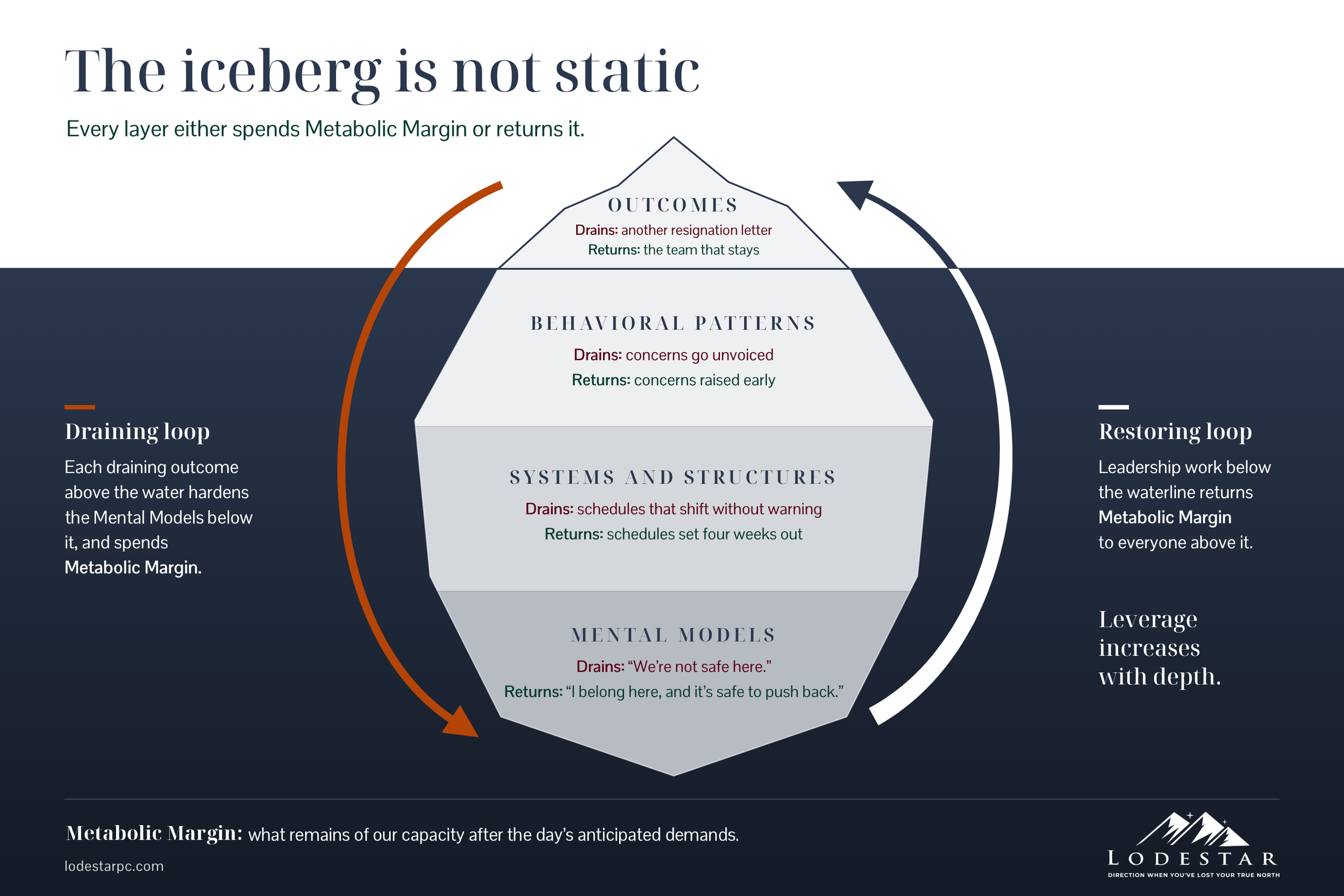
Systems theorist Donella Meadows ranked the places to intervene in a system from least to most effective, with numbers ranked least effective, and cautioned that leaders often pull the obvious levers the wrong way: “we intuitively use them backward, systematically worsening whatever problems we are trying to solve” (Meadows, 1999).
On our iceberg, numbers on a spreadsheet live above the waterline as an outcome.
On the balance sheet, people never appear as assets. They show up as expenses, and what we owe them shows up as liabilities. That framing keeps us at a distance from what is diminishing our human margin costs. Pulled without a pause to weigh the long-term ramifications, particularly for the mental models of the people who remain, that lever often worsens the problem it was meant to solve.
What shows up
Our healthcare workforce walks in already carrying a relentless, compounding load: EHR updates, restructuring, funding uncertainty, supply disruptions, the news cycle, and the perceived threat of AI. All this atop the appropriately heavy burden that comes from assuming responsibility for the lives and wellbeing of others. In the hospital, clinic, or operating room, the behavioral manifestation of this load often shows up as apathy, cynicism, and incivility, as well as interprofessional bullying and physician-management friction. These are predictable symptoms of collective, unaddressed toxic stress.
While healthcare is our example here, the pattern holds across every organization and industry in which we work where demand has exceeded capacity for too long.
Stress taxes cognition, too. The prefrontal cortex runs our highest-order thinking, and it is the brain region most sensitive to stress. Under strain, working memory and attention regulation falter (Arnsten, 2009). On the unit, that looks like presenteeism: staff who clock in, then check out. Lost productivity in healthcare isn’t a time-management problem. It’s a cognitive-load problem.
A staffing cut lands on top of all of it. And the costs that follow can dwarf any short-term gain to the bottom line.
Capacity is designed
At Lodestar, we teach Metabolic Capacity as the finite reserve of physical, cognitive, and emotional energy available to absorb the day’s demand. Metabolic Margin is what remains of that capacity after the day’s anticipated demands: the reserve that absorbs what the day actually brings.
The brain manages that budget by prediction, anticipating energy needs before they arise, and its predictions save energy by minimizing uncertainty (Barrett & Miller, 2026). Whether people have margin left at the end of a shift is determined in part by how the system is designed: schedules, staffing, who gets told what and when, how errors are reviewed and, most importantly, how much trust, safety and connection exist amongst the team and between the team and leadership. Every component either returns energy to individuals operating inside the system, or further drains them.
Staffing cuts may increase the financial margin, at least in the short term and on paper. They also alter the metabolic load in the system. Rarely are reductions in workforce accompanied by reductions in workload. Instead, the work is redistributed, absorbed by those who remain, drawing down their margin. What once felt like manageable stress becomes chronic or toxic, and depletion pushes the nervous system into a braced state. On the unit, that looks like sick calls, short tempers, and resignations.
Burnout drives a real share of those exits. Among US nurses who left a job in 2017, 31.5% named burnout as a reason (Shah et al., 2021). Every resignation adds load to the people who stay, and the next resignation comes sooner. The cut starts a metabolic drain, and a cycle of significant, hidden costs follows.
This cycle negatively reinforces the mental models at the base of the iceberg. At Lodestar, we teach leaders that Story Follows State: a nervous system running low on margin predicts threat. News of a cut lands on people who are already depleted, and the mental models (I’m expendable. Leadership is hiding the truth. It isn’t safe to say what’s wrong.) built from this state reinforce cycles of harm and depletion, outlive the cut, and continue draining margin long after the savings are booked.
The executive floor and the clinical floor experience that loop differently. Upstairs, the budget balances. On the unit, people carry the load. The next crisis sits just around the corner, out of view from the C-suite, and the people who can see it coming have learned it isn’t safe to say so.
Three pauses before a cut
Sometimes the cuts are inevitable. The subsequent departures and depletion don’t have to be.
Pause 1
Sign in and get proximate. Who is in the room? Who will carry the load going forward? What environmental or cultural elements might help ease the load? Before the decision is made, spend time proximate to the people who carry the work every day: Proximity is Protective. Those covering the units know what the budget doesn’t: which roles are already metabolically taxed and covering vacancies; which units are one resignation from unsafe.
Pause 2
Call a time-out and get very clear about what is known and what may be invisibly unknown. Name the savings, then name the costs the savings will create in turnover, overtime, agency staffing, and errors. Enumerate what remains uncertain, and spend time searching for the high-risk “unknown-unknowns.” Then actively reduce uncertainty for the team and organization. Uncertainty is metabolically expensive: reducing it “requires cerebral energy” (Peters et al., 2017).
Pause 3
Name the “sign-out.” Tell people what changed, what did not, and when they will hear more. Offer clarity in the things that are known. Name who will carry the work forward and, particularly if the changes create an ongoing, increased burden, name this drain with clarity and work with the team to safety plan. A hard truth delivered clearly and transparently builds trust, positively impacting those high-leverage mental models at the base of the iceberg. It is also procedural fairness, the practice Trevor and Nyberg (2008) found blunts the turnover that follows downsizing.
Pausing may not generate a different decision. The pause ensures the team is seen, heard, has clarity, and that risks have been named.
Why Lodestar
Lodestar’s faculty are physicians, nurses, psychologists, healthcare executives, and attorneys with firsthand experience of clinical pressure and institutional strain. We come from the organizations we work with; we are the professionals we coach and train.
Lodestar tools and frameworks are designed as immediately actionable and universally applicable. We build from a neurophysiological framework, intervening at the highest leverage point available: the mental models that exist within the individual and organization.
If your metabolic margins are running a bit thin, learn more about Lodestar’s proven capacity-building and advanced leadership development programs and book a call at lodestarpc.com.
We know your job is hard; it doesn’t have to become harmful.
References
Arnsten, A. F. T. (2009). Stress signalling pathways that impair prefrontal cortex structure and function. Nature Reviews Neuroscience, 10(6), 410–422. https://doi.org/10.1038/nrn2648
Barrett, L. F., & Miller, E. K. (2026). Categorization is ‘baked’ into the brain. Nature Reviews Neuroscience. https://doi.org/10.1038/s41583-026-01036-2
Meadows, D. (1999). Leverage points: Places to intervene in a system. The Sustainability Institute. https://donellameadows.org/archives/leverage-points-places-to-intervene-in-a-system/
Merry, A. F., & Barraclough, B. H. (2010). The WHO Surgical Safety Checklist. Medical Journal of Australia, 192(11), 631–632. https://www.mja.com.au/journal/2010/192/11/who-surgical-safety-checklist
NSI Nursing Solutions. (2026). 2026 NSI National Health Care Retention & RN Staffing Report. https://www.nsinursingsolutions.com/documents/library/nsi_national_health_care_retention_report.pdf
Peters, A., McEwen, B. S., & Friston, K. (2017). Uncertainty and stress: Why it causes diseases and how it is mastered by the brain. Progress in Neurobiology, 156, 164–188.
Shah, M. K., Gandrakota, N., Cimiotti, J. P., Ghose, N., Moore, M., & Ali, M. K. (2021). Prevalence of and factors associated with nurse burnout in the US. JAMA Network Open, 4(2), e2036469. https://doi.org/10.1001/jamanetworkopen.2020.36469
Trevor, C. O., & Nyberg, A. J. (2008). Keeping your headcount when all about you are losing theirs: Downsizing, voluntary turnover rates, and the moderating role of HR practices. Academy of Management Journal, 51(2), 259–276. https://www.jstor.org/stable/20159508